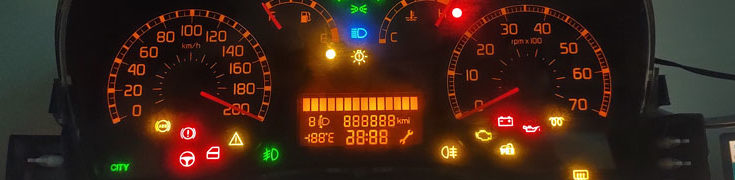


On the subpages of this page – you’ll find my findings regarding the Fiat’s CAN messages
| CAN ID (11 bit) | CAN ID (29 bit) | Function | Length | Comment |
|---|---|---|---|---|
| 0x180 | 0x02214000 | Lights & convenience | 5 bytes | |
| 0x281 | 0x04214001 | Engine status | 8 bytes | |
| 0x282 | Power steering | |||
| 0x2A0 | 0x04294000 | Speed | 4 bytes | RPM’s in 0x281 must be higher than 0 |
| 0x380 | 0x06214000 | Vehicle electrics | 8 bytes | |
| 0x3C0 | Steering lockout | |||
| 0x545 | Car radio status (+frequency) | |||
| 0x565 | RDS message body | 7 bytes | ||
| 0x6D7 | Diagnostic message, set date & time | 6 bytes |
These are the messages I know so far. All of them will be described on subpages of this page. Some of the values are bit-based (e.g. B00000001 – something is on, B00000000 – something is off) and can be summarized into one byte (e.g. B00000001 (0x01) + B00000010 (0x02) equals B00000011 (0x03) and so on).
CAN bus is quite idiot-proof 😉 so – to simplify things – you can always send 8-byte long messages despite the actual length expected by the controller (it will simply ignore extra bytes) as long, as the last/non-existent bytes will be 0x00.